A century in transformation
The last decades of the eighteenth century were a period of restlessness and great mobility of ideas.
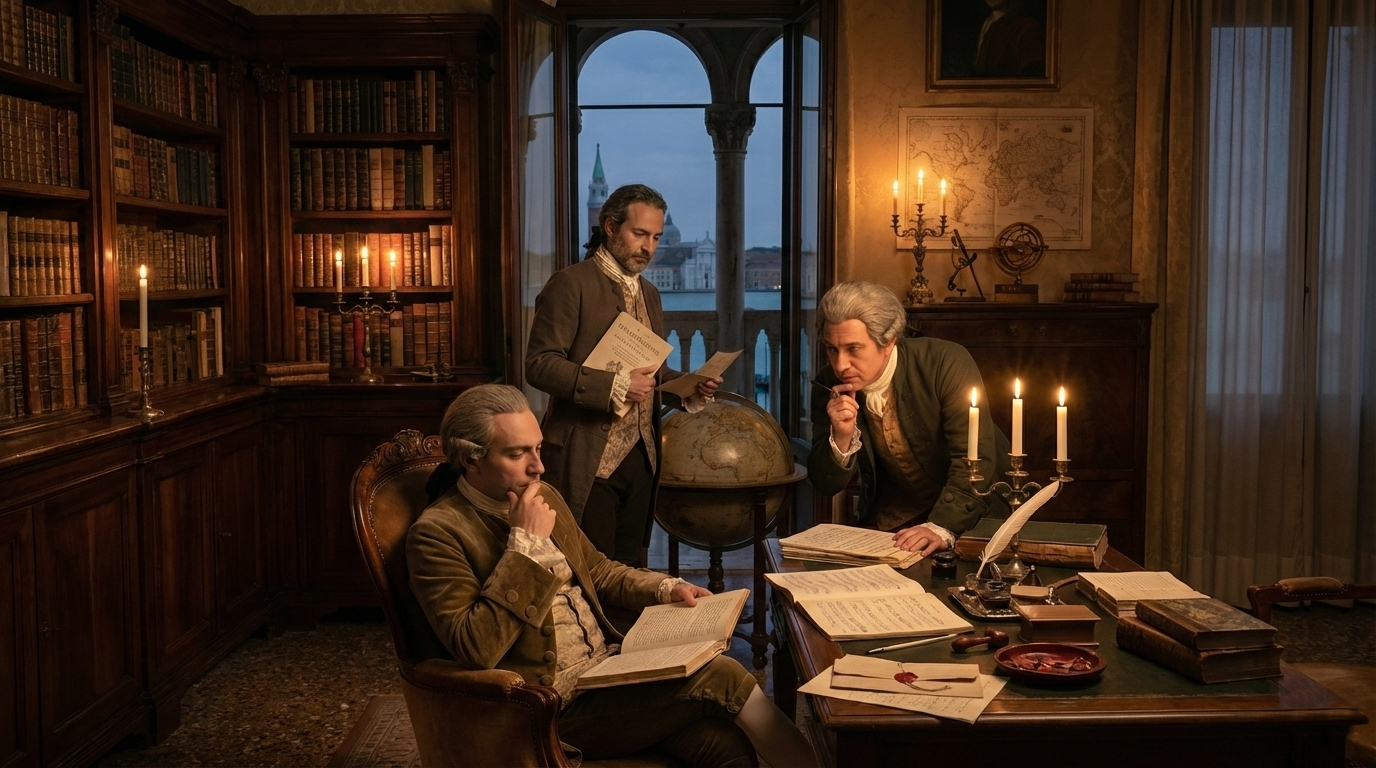
Pietro Zaguri, who remained in his Venice, and Giacomo Casanova, now settled in Dux, observed the same events from different perspectives but united by an identical awareness: the aristocratic world in which they had grown up was losing its shape.
Their epistolary dialogue restores, almost in filigree, the cracks in a political and social order that seemed immutable, but instead was rapidly heading toward dissolution.
Zaguri and the French Revolution
When the first news of the French Revolution reached Venice, Zaguri followed its developments closely, alternating between curiosity and disquiet.
In the sonnets and epigrams he sometimes sent to friends, and in the reflections he shared with Casanova, he commented:
- the violence of the revolutionaries,
- The fall of the monarchy,
- the execution of the king, an event that shocked the whole of Europe.
While critical of the excesses, he perceived that those ideas-while distant-were also shaking the foundations of Venetian society.
The crisis of the Venetian patriciate
Zaguri, who was intimately acquainted with Venetian political life, was often harsh in his judgment of his own class.
He sometimes called it tired, disinclined to duty, too attracted to worldly pastimes to notice the cracks opening in the system of government.
In a sentence that became famous in his letters, he wrote:
“For everything you are better off than in the Council, always; in the Senate almost always; in the Magistrates you are better off in the Bath.”
A bitter joke that encapsulates the perception of a ruling class refractory to change.
Even his son showed sympathy for democratic and bourgeois ideas, a sign of a generational transformation impossible to ignore.
Casanova from Bohemia
Casanova, who had held the position of librarian in the Bohemian castle of Dux since 1785, was living the same historical phase with a different but no less intense awareness.
Zaguri’s letters were for him a bridge to Venetian life and to the movement of ideas that was running through Europe.
From the stark silence of Bohemia, he observed the waning of the aristocratic world of his youth:
the salons, the brilliant conversations, the power games, everything seemed to lose substance as new ideologies reshaped the social order.
Napoleonic victories
The arrival of French troops in Italy and Napoleon Bonaparte ‘s victories had a devastating impact on Venice.
Zaguri followed events closely, commenting on them in his letters with a bitter irony, aware that La Serenissima no longer had the tools to resist.
The arrival of French troops in Italy and Napoleon Bonaparte ‘s victories had a devastating impact on Venice.
Zaguri followed events closely, commenting on them in his letters with a bitter irony, aware that La Serenissima no longer had the tools to resist.
The dissolution of the Republic in 1797 marked the end of a millennia-old political system.
For Zaguri, it was a very hard blow: a sunset not only institutional, but also cultural and existential.
A shared epilogue
Casanova died first, in 1798, far from his hometown.
Zaguri followed him a few years later, in March 1806, leaving his wife a now-drained estate, almost a material symbol of the decline of his family and the patrician class to which he belonged.
The lives of the two friends-so different and so deeply intertwined-both end in the shadow of the same epochal change: the end of the Serenissima, and with it the end of a world that had defined their identity.